
 By
By An automatic gate gives your home character, security, and convenience all at once. But like every mechanical system, it will not last forever without care. The trouble is that most gate problems do not announce themselves loudly at first. They start small and gradually get worse. By the time the gate completely stops working, the repair is usually bigger and more expensive than it needed to be. This guide covers the top signs that tell you automatic gate repair is overdue — and what to do the moment you spot them.
Sign One: The Gate Moves Slower Than Usual
Speed is one of the first things to change when a gate system starts to struggle. If your gate used to open in five seconds and now it takes ten or fifteen, something is wrong. The motor may be straining against increased resistance, the track may have debris buildup, or the drive mechanism may be wearing out.
Why Slow Movement Gets Worse Fast
A motor that works harder than it should heats up faster. Heat accelerates wear on internal components. A gate that moves slowly today is a gate that stops moving entirely next month if nothing is done.
Sign Two: The Gate Reverses Without Hitting Anything
Your gate has built-in safety sensors that reverse movement if the beam is broken or if the operator senses unexpected resistance. When the gate reverses for no apparent reason, those sensors are either misaligned, dirty, or malfunctioning.
Common Causes of Phantom Reversals
- Leaves, cobwebs, or debris covering the photo-eye lens
- Sensors knocked out of alignment by vibration or accidental contact
- Wiring issues causing intermittent signal loss
- Control board faults sending incorrect signals to the operator
This is a fixable problem in almost every case. A technician can clean, realign, and test the sensors in a single visit.
Sign Three: The Remote Works Inconsistently
If you have to press the remote button multiple times or hold it in a specific spot to get the gate to respond, the issue could be with the remote itself, the receiver on the gate operator, or interference from nearby devices. In some cases it is simply dead batteries. In others it is a failing receiver board.
How to Tell the Difference
Try a fresh set of batteries first. If the problem persists, have a technician check the receiver and antenna. Older systems may also benefit from a frequency upgrade for better range and reliability.
Sign Four: You Hear Grinding, Scraping, or Clicking Sounds
A quiet gate is a healthy gate. Any new or unusual sound is your system telling you something is wrong. Grinding usually means metal-on-metal contact where there should be lubrication or separation. Scraping often means the gate has shifted and is dragging against the ground or frame. Clicking can indicate a failing relay or control board.
Do Not Ignore Sounds That Are Getting Louder
What starts as occasional noise becomes constant. Constant noise becomes physical damage to the gate, the track, or the motor. Addressing sounds early is always cheaper than waiting.
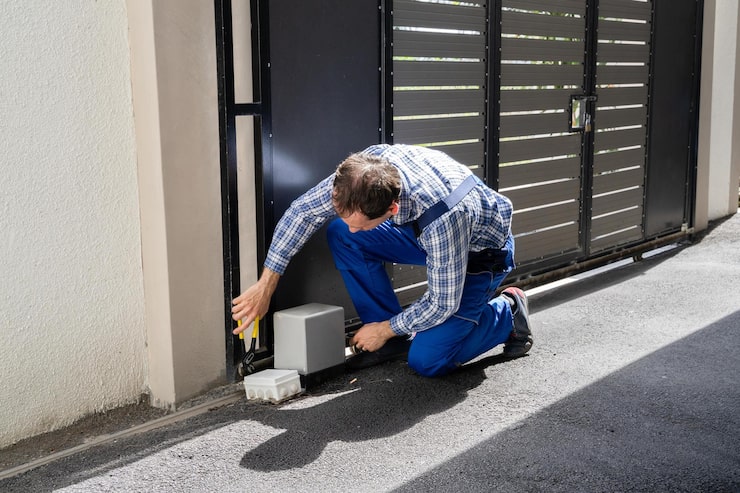
Sign Five: The Gate Is Visibly Off Track or Leaning
A slide gate that rides on wheels along a track can jump the track after an impact, after significant wear on the rollers, or when the track becomes bent or misaligned. A swing gate that leans or sags has hinge or arm wear that will worsen with every cycle.
Why Off-Track Gates Are Dangerous
An off-track gate can fall unexpectedly, especially under its own weight. This poses a serious injury risk and can cause significant damage to vehicles or property nearby. Stop using the gate immediately and call for service.
Sign Six: The Gate Opens or Closes on Its Own
A gate that moves without being triggered is not just inconvenient — it is a security and safety problem. This behavior usually points to a failing control board, a stuck relay, or interference from a neighbor’s remote operating on the same frequency.
What a Technician Will Check
- Control board for relay faults and voltage irregularities
- Remote frequency for conflicts with neighboring systems
- Wiring for damage or short circuits causing false triggers
Sign Seven: The Motor Runs but the Gate Does Not Move
This is one of the clearest signs of a mechanical failure. The operator is receiving the signal and the motor is engaging, but the gate itself is not responding. The most common cause is a broken drive mechanism, a stripped gear, or a gate that has become physically stuck in its track or hinges.
Ace Garage Door and Gate Co has been diagnosing and fixing exactly these kinds of problems across Orange County since 2006. Their technicians carry common parts on their trucks and resolve most issues in a single visit.
What to Do When You Spot These Signs
Do not wait for a complete failure. The moment you notice any of these signs, pick up the phone. The longer you operate a gate with a developing fault, the more components get affected and the higher the repair cost climbs.
Ace Garage Door and Gate Co provides electronic gate repair services for residential, commercial, and multi-family properties across all of Orange County. They handle all major gate brands and operator types and offer transparent pricing before any work begins.
Conclusion
Your automatic gate is protecting your property every single day. When it starts showing warning signs, it deserves prompt attention. Whether it is moving slowly, reversing without reason, making strange sounds, or refusing to move at all, these are not problems that fix themselves. Call Ace Garage Door and Gate Co at (714) 489-5136 today. They will diagnose the issue honestly, explain what needs to be done, and fix it right the first time. That is what nearly two decades of trusted local service looks like.


