By
By I’ve gardened in soil my whole life. My parents had a backyard vegetable patch, and I grew up thinking that’s just what gardening was — dirt under your nails, a hose, and a lot of weeding. So when I decided to run a side-by-side comparison between my usual raised soil bed and a vertical hydroponic tower, I genuinely expected the soil bed to win. I wanted to see by how much.
It didn’t go the way I expected.
Why I Decided to Run This Comparison
I’d read all the claims — faster growth, less water, no soil mess — but claims are easy to write and hard to verify from a product page. So I set up two identical mini-experiments at the same time, same starting date, similar plant varieties, and just paid close attention for three months.
Setting Up Both
I wanted this to be as close to a fair fight as I could make it without a lab coat and a clipboard.
The Soil Bed
This part was familiar territory. A raised bed, basic potting mix, lettuce, kale, and a couple of pepper plants. Standard watering can, standard schedule — water every other day, more if it got hot. Weeding once a week, sometimes twice if I let it slide.
The Grow Tower
For the hydroponic side, I went with a grow tower, specifically the ALTO Garden GX Hydroponic Tower, since it came with everything already built in — water pump, reservoir, timer, and full-spectrum LED lights so I didn’t have to think about sunlight angles. I planted the same three crops: lettuce, kale, and peppers, split across the 24 pots so I’d have enough of each to actually compare a harvest, not just one sad pepper plant.
Week 1–4: Early Growth
Both started slow, which honestly surprised me a little — I expected the tower to take off immediately. The first two weeks looked nearly identical between the two setups. If anything, the soil bed had a slight visual edge early on, just because the plants looked a little fuller from day one.
By week four, that changed. The tower plants were noticeably catching up, and the lettuce in particular had outpaced its soil counterpart.
Week 5–8: Where Things Started to Diverge
This was the stretch where the difference became obvious, not just to me, but to my partner, who had been mostly indifferent to the whole experiment up to this point and suddenly started asking why the tower lettuce looked so much bigger.
A few things I noticed during this period:
- Watering stopped being a daily task for the tower. The timer handled it, and I genuinely lost track of how often it was running because I just didn’t need to think about it. The soil bed still needed my attention every other day, and during one hot week, every single day.
- Weeds were a non-issue for the tower, obviously, since there’s no soil for anything to take root in. The soil bed needed weeding twice in this stretch.
- Root health in the tower looked different than I expected — thicker, more developed root systems than the same plants in soil, likely from the extra oxygen exposure between watering cycles.
Week 9–12: The Final Stretch
By the final month, the kale and lettuce in the tower were ready for harvest noticeably sooner than the soil bed equivalents. The peppers took longer in both setups, which tracks since peppers are just a slower-growing crop regardless of method, but even there the tower plants looked healthier and more uniform in size.
The soil bed plants weren’t bad. They grew, they produced food, and if this had been my only garden, I would have been perfectly happy with it. But next to the tower, the difference in consistency was hard to ignore. Every pot in the tower grew at roughly the same rate. The soil bed had winners and losers depending on which spot got more direct light or better drainage.
The Numbers: Water, Time, and Harvest
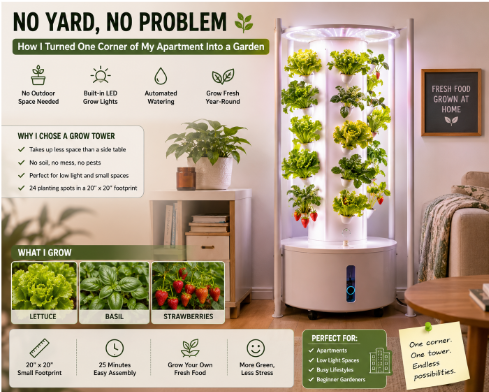
Tracking actual time and water use was the most convincing part of this whole experiment for me.
- Watering time: Maybe 10 minutes a week total for the tower (mostly just topping off the reservoir). The soil bed took closer to 20–25 minutes a week between watering and weeding combined.
- Water usage: This was the biggest surprise. The tower recycles water up and down through the system instead of letting it soak into the ground, and the difference in actual water consumed was significant — easily less than half of what the soil bed used over the same period.
- Harvest timing: The lettuce and kale in the tower were ready roughly a week to a week and a half earlier than the soil bed crops.
What I’d Tell Someone Deciding Between the Two
If you’ve got the space, the patience, and you enjoy the process of working with soil, there’s nothing wrong with sticking to a traditional garden. I still think there’s something satisfying about it.
But if you’re trying to optimize for less time, less water, and more consistent results — especially if you don’t have a big yard to work with — the tower made a stronger case for itself than I expected going in. I didn’t think a vertical hydroponic system could outperform a setup I’ve used my whole life, but three months of side-by-side growth was hard to argue with.
Final Verdict
I went into this expecting to write a “well, it’s a fun gadget but soil still wins” kind of post. Instead, I came out of it using the tower for more of my everyday growing than the soil bed. Old habits are hard to break, but the results spoke for themselves this time.